Sophie, tu en veux ?
Sophie, would you like some?
Learn French in Manila

Manon entre dans la classe en mangeant des chocolats.
Manon enters the classroom eating chocolates.


Merci, c’est très gentil.
Thank you, that’s very kind.
Thank you, that’s very kind.
Et toi, Eri ?
And you, Eri?
And you, Eri?

Merci, mais je suis allergique au chocolat.
Thanks, but I’m allergic to chocolate.
Thanks, but I’m allergic to chocolate.
Oh, pardon. Et vous Peter, Luca ?
Oh, sorry. And you, Peter, Luca?
Oh, sorry. And you, Peter, Luca?

Oh, j’adore les chocolats.
Oh, I love chocolates.
Oh, I love chocolates.

J’en veux bien, merci.
I’d love some, thanks.
I’d love some, thanks.
Ah bon ! Tu es allergique au chocolat ?
Oh really ? You’re allergic to chocolate?
Oh really ? You’re allergic to chocolate?
Oui. J’ai toujours mal au ventre quand je mange du chocolat. J’ai également du mal à respirer.
Yes. I always have a stomachache when I eat chocolate. I also have trouble breathing.
Yes. I always have a stomachache when I eat chocolate. I also have trouble breathing.
C’est terrible. Pour moi, c’est le pollen. J’ai le rhume et j’ai les yeux rouges. C’est pour ça que j’évite parfois le parc. Il y a tellement d’allergènes que je n’y vais pas.
That’s terrible. For me, it’s pollen. I get colds and red eyes. That’s why I sometimes avoid the park. There are so many allergens that I don’t go there.
That’s terrible. For me, it’s pollen. I get colds and red eyes. That’s why I sometimes avoid the park. There are so many allergens that I don’t go there.
Pour ma part, j’ai souvent mal à la tête. J’ai des migraines quand je bois trop de café ou quand je mange trop de chocolat. Mais je continue à en manger.
As for me, I often get headaches. I get migraines when I drink too much coffee or eat too much chocolate. But I keep eating it.
As for me, I often get headaches. I get migraines when I drink too much coffee or eat too much chocolate. But I keep eating it.
Peut-être que c’est mon âge. J’ai toujours mal au dos.
Maybe it’s my age. My back always hurts.
Maybe it’s my age. My back always hurts.
Moi, j’ai mal aux genoux à cause d’un accident au skate park. Mais j’y vais quand même de temps en temps pour faire du skate.
My knees hurt because of an accident at the skate park. But I still go there from time to time to skate.
My knees hurt because of an accident at the skate park. But I still go there from time to time to skate.

Excusez-moi, mais s’agit-il d’un cabinet médical ici ?
Excuse me but is this a doctor’s clinic?
Excuse me but is this a doctor’s clinic?

Read the following sentences:
- Tu en veux ? → Would you like some?
- J’en veux bien. → I’d like some.
- Je n’y vais pas. → I don’t go there.
- Je continue à en manger. → I keep eating it.
- J’y vais quand même. → I still go there from time to time.
When Manon was offering the chocolates, she asked “Tu en veux ?” (Do you want some?) Sophie, on her part, when referring to the park says: “Je n’y vais pas.” (I don’t go there.)
En and y are what we call adverbial pronouns. To avoid repetition, we use en to replace quantities. So instead of Manon having to use the words “des chocolats” she instead used “en.” It is always placed before the verb.
- Tu veux des chocolats ? → Would you like some chocolates?
- Tu en veux ? → Would you like some?
Meanwhile, y replaces places that are introduced by à, chez, en, dans, sur, sous, etc. So, instead of using “au parc,” Sophie used y. Like en, it is also placed before the verb.
- Je ne vais pas au parc. → I don’t go to the park.
- Je n’y vais pas. → I don’t go there.
En and y, of course, have many uses. We will be discussing those in the future lessons.

Notice also the adverbs of frequency used by Sophie, Eri, Luca, Peter and Manon. Adverbs of frequency are placed after the verb.
| toujours | always |
| souvent | often |
| parfois, quelquefois | sometimes |
| de temps en temps | from time to time |
| rarement | rarely |
| jamais | never |

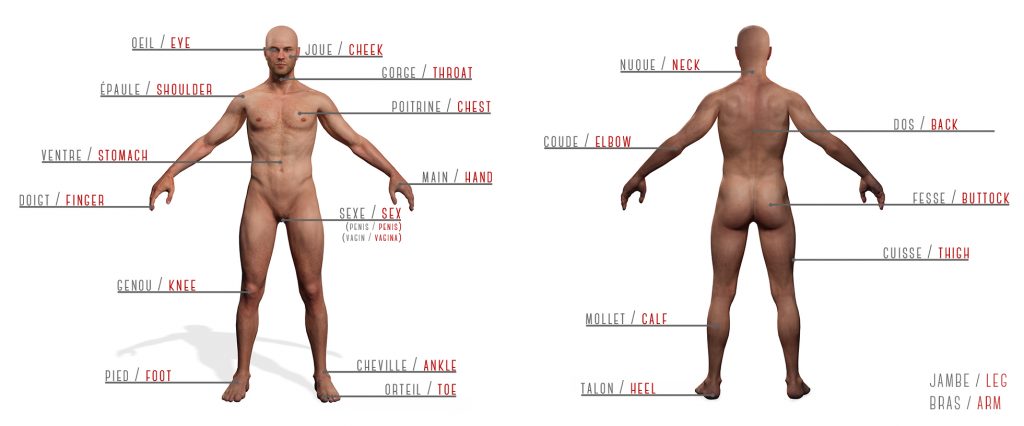
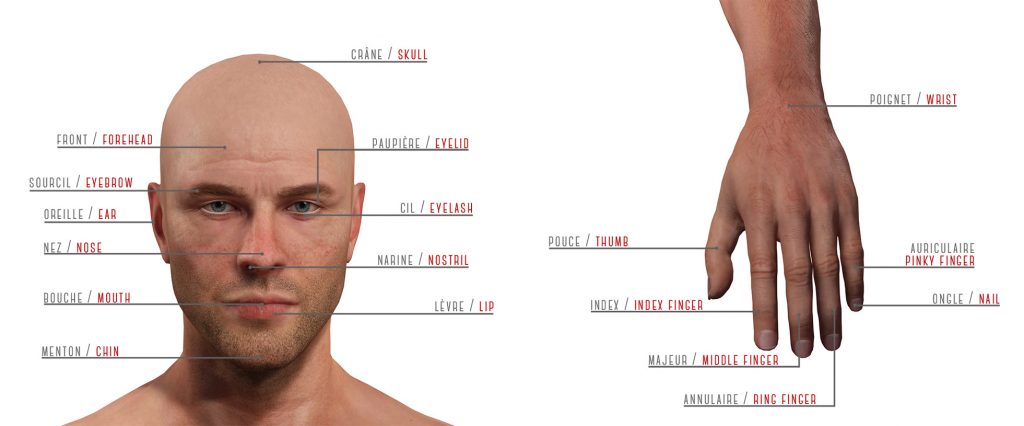
In French, when we talk about sicknesses, we use the verb “avoir mal à” + the part of the body. As we have learned in the previous lessons, the preposition à changes in accordance to the number and gender of the body part.
Avoir mal à… → To have pain in…
| Masculine | Feminine | Vowel | Plural |
| au | à la | à l’ | aux |
| J’ai mal au dos. | J’ai mal à la tête. | J’ai mal à l’estomac. | J’ai mal aux dents. |

| J’ignore | Nous ignorons |
| Tu ignores | Vous ignorez |
| Il / Elle ignore | Ils / Elles ignorent |
| J’évite | Nous évitons |
| Tu évites | Vous évitez |
| Il / Elle évite | Ils / Elles évitent |

In this part, you will be given phrases that you can use for conversations of different kinds.
- J’ai un rendez-vous avec le docteur ___ à ___ . → I have an appointment with Dr. ___ at ___ .
- Voici ma carte d’assurance maladie. → Here is my health card.
- J’ai mal ____ → I have a ___ ache.
- J’ai de la fièvre. → I have a fever.
- Je tousse. → I cough.